
Yesterday, Statistics Iceland published new data on population development. Every year, the staff of the North-East Iceland Knowledge Network compile data on population development in the network's area of operation, and that work began as soon as the data had been published.
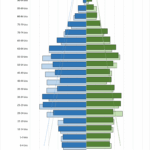
Initial figures and calculations show that the population of the area increased by 45, from 5,007 to 5,052. The sex ratio is similar to previous years, with 531 males and 471 females. The average age of the population is 41.2 years.
If individual settlements are examined, the population decreases in Laugar, Kópasker and Bakkafjörður, but increases in Húsavík, Reykjahlíð, Raufarhöfn and Þórshöfn. The population in rural areas decreases around Kópasker, Þórshöfn and Bakkafjörður, but otherwise increases in the vicinity of Húsavík, Reykjahlíð and Laugar. In the vicinity of Raufarhöfn, the population remains unchanged.
The largest percentage increase in population is in Tjörneshreppi, at 8.93%, which is the second-largest percentage increase in the entire country. Next is Skútustaðahreppi with 2.55%, and finally Þingeyjarsveit with 1.8%.
The median age of residents is falling in all municipalities except for Norðurþing and Svalbarðshreppur. The median age is highest in Tjörneshreppur, at 56 years, compared to 57.9 in 2021. It is lowest in Langanesbyggð at 39.3 years, compared to 40.6 years in 2021. The average age for the whole country is 38 years, and it has decreased by 0.4 years between 2021 and 2022.
The population report will be published in the coming weeks, but until then, those interested can browse older reports, which can be found under 'Research' on the homepage of www.hac.is and under that section. Published material
 .
.