
The Krubbur Idea Sprint was held at Stéttin in Húsavík on 8-9 March. The Hraðið Innovation Centre hosted the event in collaboration with KLAK-icelandic startups, with support from a grant from the Lóa Innovation Fund. This is a collaborative project with companies in the region and the business support system, such as SSNE, Eim, Norðanátt, etc.
Around 70 guests attended the event, with 30 participants in 7 teams. The focus was on innovation opportunities based on the use of raw materials that are by-products of companies in the local area. The idea sprint went extremely well, and there was a great turnout and a lively atmosphere all weekend at STÉTTIN. People of all ages took part and tackled fun challenges. Several very interesting innovation ideas were presented and awarded prizes. The weather was kind to visitors and participants in Húsavík this weekend, with sunshine and an early spring in the air. The midnight sun and starry skies greeted participants during their visit to Geosea, and the town was buzzing with life, including at the local microbrewery, Húsavík-öl, at the end of the programme.
The Hraðið Centre for Innovation will host the Krubb Idea Accelerator annually and is already planning next year's event.
Interesting innovative ideas were presented, including the following:
- Development of reinforced concrete forms using quartz material generated during production at the PCC silicon metal plant.,
- Reusing textile waste for clothing production, including the use of energy for drying and ironing.
- Development and production of sensory clothing for children with special needs.
- Recycling plastic waste from beaches to produce plastic yarn for clothing, for regional sale to environmentally-conscious travellers.
- Establishment of a Waste-Lab facility based on the analysis and research of opportunities for recycling and related regional activities for utilisation and product development.
- Utilisation of quartz material generated during production at the PCC silicon metal plant for the development of plastic/stone composite worktops, stone, etc.
- Utilising plastic waste from coastlines to create a substrate that can support the development of ecosystems ('urban reefs') and/or as an ecosystem-forming infill material.
Winning ideas:
Below is a more detailed description of the four ideas that received awards.
Photographs and
STRONG CONCRETE – 300,000 króna prize from PCC BakkiSilicon
The Strong Concrete project won first prize in the PCC Bakki Silicon challenge, which was about creating an opportunity from the 3,000 tonnes of quartz sand the company produces each year.
The team included Ingibjörg Benediktsdóttir, project manager for the Civil Protection Authority and public emergency officer; Methúsalem Hilmarsson, a specialist in risk assessment and security; Knútur Jónasson, a registered architect; and Sigurður Páll Tryggvason, who has many years of experience in construction.
The team presented a new product which bears the Icelandic name Defence corner and is designed to create defence barriers against natural hazards, such as lava flows, water and mud. The block is precast from a quartz-mixed concrete, which provides increased hardness while also offering greater resistance to wear and chemicals than conventional concrete. Each unit weighs approximately 1,400 kg and is arranged into defence walls, while also being stackable tightly to facilitate their transport.
The corners could have been used in the landslides at Útkinn to create a safe path while the farmers had to be transported to milk the cows. They could also have been laid over water pipes for protection during lava flows on the Reykjanes Peninsula. The target group is the government, local authorities, businesses and individuals, and the team's next steps are to seek funding and work on the further development of the units.
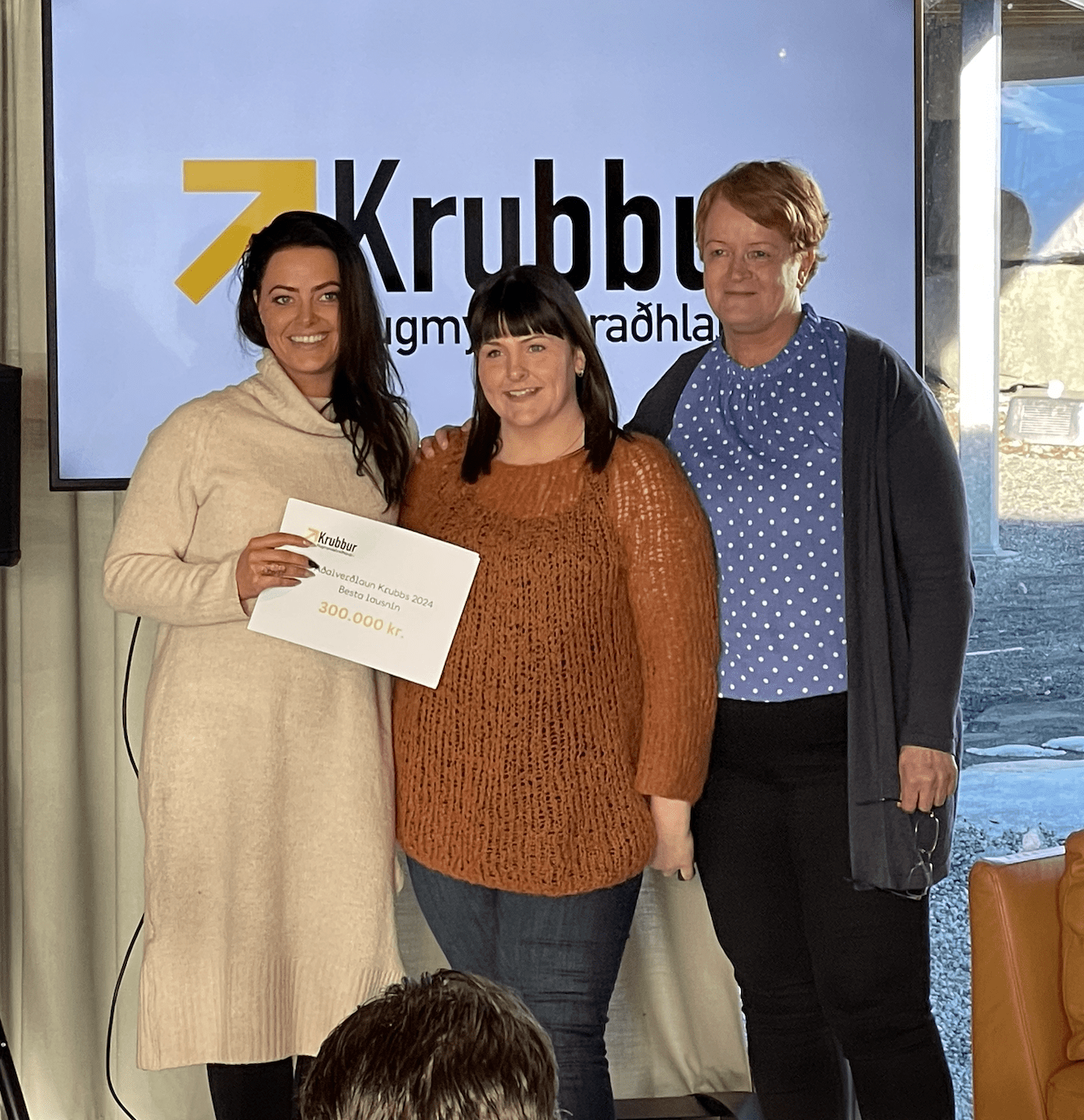
HUGARRÓ – 300,000 kr. Krubb's Main Prize 2024
The main prize for Krubb went to Júlia Margrét Birgisdóttir and Sólveig Ósk Guðmundsdóttir.
They presented their idea for producing sensory clothing for children with behavioural difficulties. Currently, there is a very limited supply of products that meet the sensory needs of individuals with diagnoses such as autism, ADHD and anxiety. Their idea is to design a jumper made from recycled material that features special soundproofing and a visor in the hood. It would also have a roll-neck, fidgets in the pockets, cuffed sleeves and a fabric suitable for children with sensory processing difficulties.
The team members have many years of experience in a nursery, as well as both having children with autism and ADHD.
GREENWAVES – 100,000 króna prize from Ocean Missions/Norðurþing
The Greenwaves team presented a solution to the Ocean Missions challenge of plastic pollution in the sea. The project involved using recycled plastic bottles to create plastic yarn, which would then be used to produce clothing. The target group is tourists who visit Húsavík each year. The marketing and promotion of the clothing places a strong emphasis on ocean issues and environmental protection. The team consisted of Matteo, Rodrigo, Michal, Gaia and Valentina, who are all at the University of Iceland's Research Centre in Húsavík, where they are working on research projects in Skjálfandi.
Naked – 200,000 króna prize from the Icelandic Container Federation
The team that won the Icelandic Container Society's challenge was called Nakedness and its members are Aldey Unnar Traustadóttir, Þóra Katrín Þórsdóttir, Björg Sigurðardóttir, Helga Dagný Einarsdóttir and Arna Þórarinsdóttir. Their project is about recycling textile waste. By shredding textile waste in special machines, a fibre ball is created, and from it, thread is spun for garment production. Their vision is to weave the fabric themselves, but initially the main focus will be on cleaning and spinning the yarn. The project's unique feature is utilising local energy for the cleaning and drying of the textile.